Birth and Death Registration Face New Hassles


 March 30, 2026 9:34 pm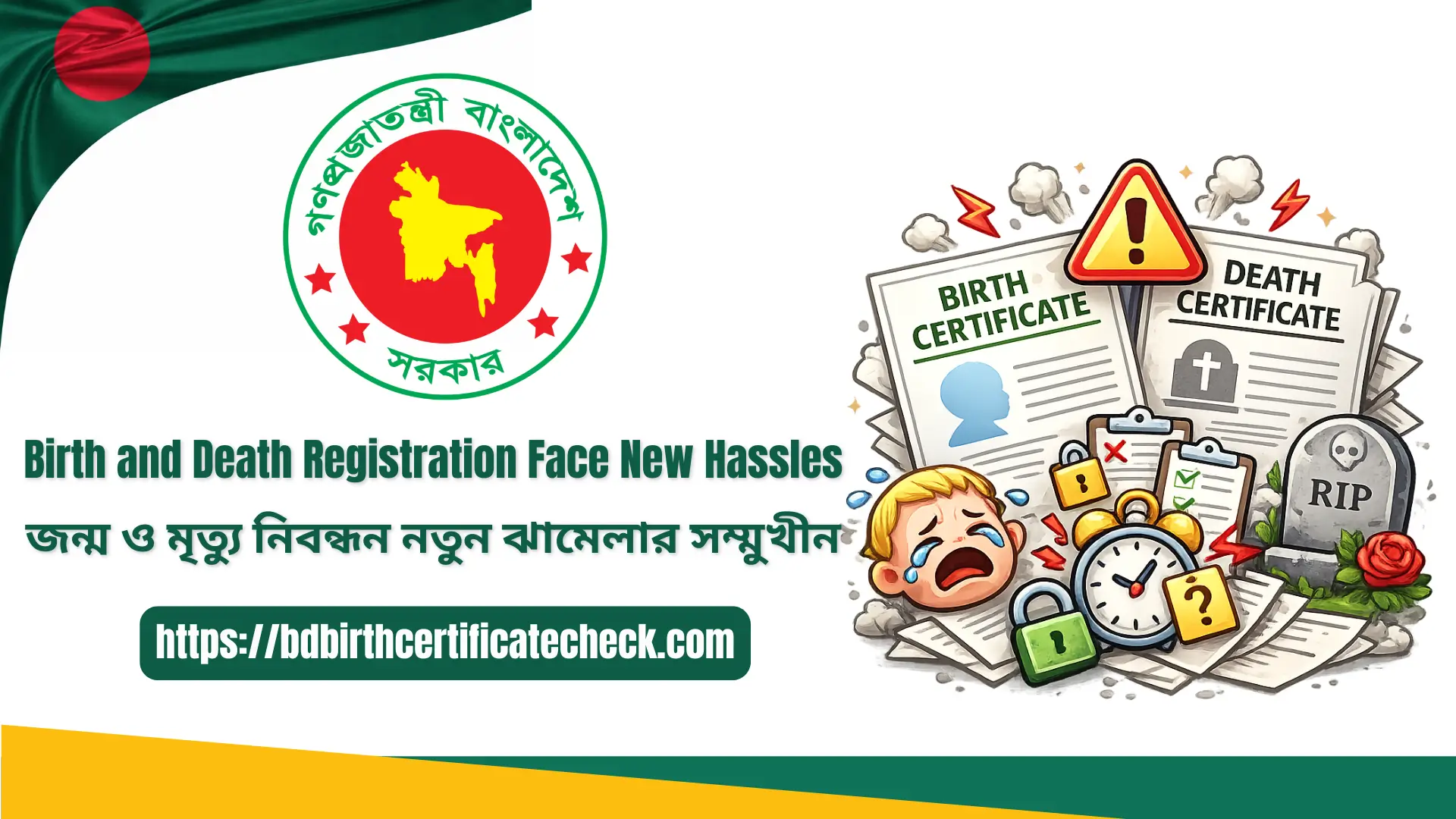
Birth and death registration is a vital administrative process in Bangladesh, as it establishes citizens’ legal identity and helps maintain accurate demographic records. Recently, however, disruptions in the online fee submission system have created serious difficulties for applicants.
Due to technical problems and the need for manual payments, many citizens are facing added complications during registration. This article examines the causes of these issues, their impact on the public, and potential solutions to improve and simplify the registration system.
Manual Payment Hassles for Birth and Death Registration
A major challenge in birth and death registration has been the temporary suspension of e-payment services. Since the last week of November, applicants have been unable to pay registration fees online and are instead required to visit local registrar offices for manual payment, resulting in delays and inconvenience.
Previously, the e-payment system enabled smooth transactions through the finance ministry’s iBAS++ (Integrated Budget and Accounting System). However, a surge in new registrations and correction requests overwhelmed the system, forcing authorities to suspend the service.
For example, Kazi Saifuddin Hossain from Mohammadpur required his birth registration certificate for family matters, while Arefin Amin Rohan needed to correct his own and his parents’ names on their certificates. Although both applied online, they ultimately had to visit the registrar’s office to manually pay the Tk 50 fee.
Who is Responsible for Registration?
The responsibility for birth and death registration is assigned to ward councilors, municipality mayors, and Union Parishad chairmen. According to Syed Hasan Noor Islam, councilor of Ward No. 32 of Dhaka North City Corporation (DNCC), the e-payment system has been inactive for several months, requiring applicants to pay fees in person. These fees are subsequently deposited into the state treasury through Challan.
High Volume of Applications
The number of birth and death registrations in Bangladesh is significant. On 6 May alone, 58,749 manual payments were recorded, and 69,908 applications were submitted for new registrations and corrections. From January to April, authorities processed approximately 3.2 million birth registrations and 288,000 death registrations.
Electronic payment for these services was introduced in May 2023 after a successful pilot project in Madhainagar Union Parishad, Sirajganj, and Meherpur Municipality. The system automates payments through iBAS++, enabling the government to manage budgeting, fund distribution, and revenue collection more efficiently.
Why Was E-Payment Suspended?
The problems within the e-payment system did not arise unexpectedly. From mid-2023, birth registration became increasingly difficult due to frequent server outages. Between June and November, applicants regularly encountered system disruptions and were repeatedly notified that the server was down.
The main cause was the limited storage capacity of the Birth and Death Registration Information System (BDRIS). A surge in applications significantly slowed system performance. At the same time, data security concerns emerged after a report by the US-based technology outlet TechCrunch revealed a major leak of personal information from a Bangladeshi government website. In response, online application services were suspended throughout August 2023.
Although self-applications resumed in September, e-payment issues persisted. Users experienced delayed responses or payment failures. To address these challenges, the Office of the Registrar General, Birth and Death Registration, introduced manual payment options on 26 November 2023, and by 30 November, the e-payment system was fully discontinued.
Impact of Manual Payment System
Despite its limitations, the manual payment method resulted in a significant rise in registrations. Registrations reached 600,000 in November and exceeded 1 million in December 2023. However, applicant inconvenience continues to be a major concern.
Registrar General Md Zahid Hossain stated that more than 100,000 transactions occur daily on average, including new registrations and corrections. Due to this heavy volume, the iBAS++ system could not cope with the load, leading to its temporary suspension.
To keep services running smoothly, authorities chose to continue manual payments until the problem is resolved. At the same time, discussions are underway to introduce a dual-payment system that would allow both online and offline transactions, reducing inconvenience for citizens.
Server Upgrades and Future Improvements
Server performance has improved following the suspension of e-payments. Zahid Ferdous, secretary of DNCC Ward No. 32, stated that system downtimes now occur less frequently and usually last only one to two days.
Additionally, the government has strengthened system capacity. In April 2024, BDRIS storage was increased from 72 terabytes to 322 terabytes, enhancing the efficiency of application processing.
Possible Solutions for a Seamless Registration Process
To ensure a smooth and efficient birth and death registration process, authorities should focus on the following measures:
- Reactivation of E-Payment with System Improvements: Upgrading the iBAS++ infrastructure to better manage heavy user traffic.
- Hybrid Payment System: Maintaining both online and manual payment options for user convenience.
- Enhanced Server Capacity and Speed: Expanding server storage and performance to avoid system slowdowns.
- Stronger Cybersecurity Measures: Applying robust security protocols to protect data from breaches.
- Introduction of a Mobile Registration App: Developing a dedicated mobile application to simplify registration and reduce manual workload.
Conclusion
Implementing these improvements will strengthen the registration system’s efficiency, security, and accessibility. Upgraded infrastructure, flexible payment options, enhanced cybersecurity, faster servers, and a dedicated mobile app will ensure smoother services, reduced workload, and a more reliable digital registration experience for all users.
Raba Khan 
Hi, I’m Raba Khan. I created bdbirthcertificatecheck.com to help people easily check birth certificates online. I share simple, clear guides so anyone can understand the process and avoid confusion. My goal is to make official tasks easier for everyone.